Game Balance: Critical Vocabulary
Discussion on critical vocabulary and first parts of designing an extension to an existing game.
Game State vs. Probability Space (featuring bad math)
To start discussing about game balance, one must get familiar with the critical vocabulary around it. Starting off with “game state” and “probability space” - what are they and how do they differ?
Game state refers simply to the current state of the game. To elaborate, this could be imagined as a snapshot of the game with all relevant numbers, units, positions, resources, abilities on cooldown, and whatever written down. With everything recorded, a game state can be fully replicated. For example, in chess, if both players walk away from the board mid-game, the game state encompasses all the positions of the pieces, who’s turn it is, has a pawn recently moved two spaces (enabling en passant), and castling rights. This same state could then be replicated and other players could finish the game.
The probability space in games refers to the complete space of possible game states. In other words, it refers to everything that could ever happen in the game - which of course gets quite massive even for the simplest of games like tic-tac-toe (26 830 possible games). You can more about it here. The probability space is typically only used as a hypothetical concept since it is not very practical to calculate the probability space for, I’d argue, any game. But in a hypothetical sense, the more vast the probability space of the game, the more replayable it is due to unpredictable game states.
Short analysis of the probability space of Werewolf: Werewolf is a social game that I love to play. Let’s take an example game of Werewolf with 8 players. In the game there would be 1 or 2 werewolves with 5 to 6 villagers with one seer (special role). Playing with one seer as the only special role is the way I usually play with new players in order for them to understand how the game is played. Now let’s analyze the games probability space with 1 werewolf, 1 seer, and 6 villagers: all roles are shuffled and assigned randomly. I’m going to simplify this so that we start by assign the werewolf and the seer, and we’ll think of this as a group of 2. We can use the formula for calculating combinations where r = 2 represents the subset and n = 8 is the total population:
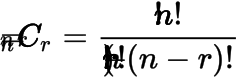
Running this formula we get a total of 28 different combinations. This of course is an incorrect calculation due to the order of the werewolf and seer chosen. The players could be chosen to be in the group of werewolf and seer, but the roles can be swapped between them. A simple way here would be to multiply the combinations by two, but the correct way is to use the permutation formula:
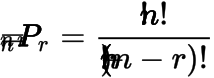
This gives us 56 different possible game states just from assigning roles. Now thinking about how the game progresses, during the night a player is killed, the seer checks someone’s identity. This means that the werewolf has to choose 1 out of 7 and the seer likewise. Now applying these numbers to the permutation we get 42. Already close to 100 different game states after the first night. Let’s ignore the calculations for the day phase due to it’s ungodly amount of possibilities and focus on the nights. The second night is dependent on whether or not someone was eliminated and whether or not the seer is alive (assuming the werewolf managed to survive to the second night and not ending the game). If no one died, we get another 42 permutations. If someone died, we first calculate how many groups (combinations) are possible on the 2nd night: 8. With 7 players left, we could have 30 permutations. EXCEPT, this is not taking into consideration whether the werewolf or seer has died. Someone could continue these calculations but it will get messy if I do it. In short, the possible game states multiply aggressively with every step of the game.
Determinism vs. Non-Determinism
Determinism refers to one action leading to another, always. This means that there exists a clear causality between game states. In a completely deterministic game, you could reach the exact same game state by following the exact same steps you took in the first game. Hardly any game is purely deterministic anymore due to determinism leading to complete predictability. The original Pac-Man is a completely deterministic game due to the ghosts having no randomness but following a certain algorithm and resulting in players just memorizing winning patterns.
Non-determinism is, of course, the opposite. The same actions don’t dictate what the next game state will be. Sure, games that are not deterministic have deterministic qualities and being purely non-deterministic would be hard to achieve (and how would that even look like?). Chess is mostly non-deterministic due to two players having multiple options of moving their respective pieces. If you start the game with e4, your opponent might often respond with the e5 but other opponents will respond differently. The first move you made did not force your opponent to play a certain opening. In contrast, there are situations in chess where your opponent is forced into a mate because of only having one legal move to choose from. Then the game is deterministic in that following those forcing moves the next game state, i.e. the next move your opponent makes, will always be the same.
Determinism in Hunt: Showdown: Hunt: Showdown is a PvPvE videogame that I enjoy. Here’s a list of three deterministic and three non-deterministic qualities in the game:
Deterministic qualities
- Dying always results in you losing a health bar or losing your character
- Health items will always heal the same amount (with modifiers)
- Experience points earned are always dependent on game objectives
Non-deterministic qualities
- A headshot will not always kill (due to range, cover, current health, ammo type,…)
- Spawn points are random
- The bosses and locations of said bosses are random
Transitive vs. Intransitive
Transitive properties refer to properties that apply to successive members of a group. In other words, if A beats B and B beats C, then A will always beat C as well. It can be represented as a chain like so: A > B > C.
Intransitive properties refer to properties that do not follow the same rules that transitive properties do to successive members of a group. If A beats B and B beats C, A doesn’t necessarily beat C. We could even say that C beats A. A simple example is Rock-Paper-Scissors. One beats another, but loses to the third. Just because rock scissors and scissors beat paper doesn’t make it so that rock would also beat paper. Intransitive properties are typically present in any game featuring some sort of weaknesses or resistances.
Transitivity in Hunt: Showdown
Transitive qualities
- Long range ammo deals more damage than medium range ammo over long distances. Medium range ammo deals more damage than short range ammo over long distances. Long range ammo will always deal more damage over long distances than short range ammo. Long > Medium > Short
- Bigger variations of the same item deal more damage than smaller ones. A big dynamite bundle deals more damage than a dynamite bundle. A dynamite bundle deals more damage than a dynamite stick. BDB > DB > DS
Non-transitive qualities
- Poison ammo deals more damage (to immolators) than fire ammo, fire ammo deals more damage (to hive swarms) than normal ammo. So in a transitive setting, poison ammo would deal more damage than normal ammo. But poison ammo is horrible against a boss called the spider and normal ammo is alright.
- Killing an immolator with knuckledusters takes less stamina than killing one with a knife. On the contrary, killing an armored zombie with a knife takes less stamina than killing them with knuckledusters.
Common, Privileged, and Hidden Information
Common information in a game refers to information available for all players. In a game of chess, the current game state can be observed by both players in it’s entirety. In Terraforming Mars, the current state of Mars, the cards played by other players, and who’s turn is it are all common information.
Privileged information is information that’s known by only one or a portion of the players. This could be, for example, in the game of Werewolf information about who is playing what role. The narrator of the game knows completely who is a werewolf (although werewolves know who werewolves are as well) but the narrator also knows what are the roles of others as well. The seer gains privileged information by asking the role of other players during the night and can either disclose it or not.
Hidden information is information that’s unknown to everybody. In a typical 52-card card game, the next card to be drawn from the top of the deck is hidden to everybody (let’s not go into exceptions).
Games can and typically have multiple layers of information. Let’s take Among Us as an example. Everybody knows the names of all other players, the map they’re playing, and the progress of the crew’s tasks making those common information. Everybody knows their own role and in the case of two or more impostors, the impostors know each other, making roles privileged information. Another example could be Munchkin, a card game. All players know the equipment, class, race, gender, and level of others (common). Everybody knows the current cards they are holding (privileged). Nobody knows what’s the next card on the top of the deck (hidden) except if someone has had a special card to peek the top cards or reorder them (privileged).
Symmetric vs. Asymmetric
Symmetric games are games that are completely mirrored for all players. This means character choices, map, abilities, starting equipment, whatever.
Asymmetric games are the opposite and mean the game is not mirrored. For example, the map is different or the starting positions are not symmetric. A lot of games might have symmetric qualities but tend to have some asymmetric qualities. Chess is close to being symmetric in terms of the starting position and pieces used but it still has one asymmetric quality - the starting player.
When discussing symmetry or asymmetry in games, they might be referred to symmetric or asymmetric depending on where do they place in a spectrum ranging from symmetric to asymmetric. League of Legends has symmetric qualities in that the team sizes and starting gold are the same, but character choices typically are restricted by what others have chosen. Same goes for the map, which has symmetric qualities in terms of the jungle camps and buffs to be had, but the layout differs.
What if a game was completely symmetric? Well, this would make it very predictable. For example, some Counter-Strike custom maps might be completely symmetric in terms of starting positions and the map could be mirrored. Custom rules could also make it so that only one type of gun can be used and nobody buys body armor. This allows players to know starting positions, guns, and health/armor of all players. In other words, information that would in other maps be privileged would be common. Players could make very informed decisions on where to position themselves and know exactly how long it would take the other players to do the same.
Positive and Negative Feedback Loops
A positive feedback loop refers to some feature adding, accelerating or amplifying itself. For example, in Monopoly once a player has gotten ahead of others in terms of owned property and money, it’s pretty clear they’ve won. The property they own keeps generating more money, which in term allows them to buy more property which generates more money etc.
A negative feedback loop refers to a feature having diminishing returns. The feature dampens itself. For example, in World of Warcraft some spells might have diminishing returns in terms of the duration of the effect it has, e.g., root, stun, silence, and so on. Spamming the same stunning spell will first stun the opponent for 4 seconds, the next stun will be 3, then 2, 1, and lastly 0.5 and be almost worthless to use. A negative feedback loop can also be observed in Mario Kart. Being the 1st means you get power ups from only a certain limited pool whereas the last players get the most powerful weapons and boosts.
Solvability
A solvable game is a game that has a certain set of steps to take to ensure victory (simply put). As in, a chain of actions will always lead to victory. There’s also different levels of solvability. Tic-tac-toe is, for example, solvable by humans. Once we have played the game for a while, we can recognize the winning patterns and whether we’re the 2nd player then we know what to do to end up in a tie.
Let’s compare Civ 6 to Darkest Dungeon in terms of solvability. Civ 6 has an incredibly huge probability space due to the sheer volume of choices to be made even before the game begins. Even if we allocate starting locations to each player manually and pick all the leaders we want to play with, an element of randomness could be added with catastrophes, which would lead to a possible hurricane destroying our farms and messing up our optimized play. Sure Civ could probably be solved with computers by eliminating as much pseudo randomness as possible but that would anyway be quite an ordeal to compute. Darkest Dungeon likewise has a massive probability space since enemy encounters, illnesses, weaknesses, strengths, damage dealt, stress gained/recovered, health regained, map layout, and random map objects are non-deterministic. This means that the game is practically unsolvable. This does not mean that there isn’t a winning strategy. A winning strategy in Darkest Dungeon would mean making choices about the team, equipment, and abilities taking into consideration the area one will embark to. Already knowing what area the player is going into narrows down the probability space and allows the player to, for example, choose items that give resistances to the most probable damage they are going to encounter.
Curves
I’ve written surprisingly long already so I’m not going to go too deep into curves, but maybe I’ll revisit this section and rewrite it. For now, I’ll just analyze the number curve of ability levels in Darkest Dungeon.
The plague doctor has the following skills: Noxious Blast, Plague Grenade, Blinding Gas, Incision, Battlefield Medicine, Emboldening Vapours, and Disorienting Blast. Here’s some of their progression through upgrading:
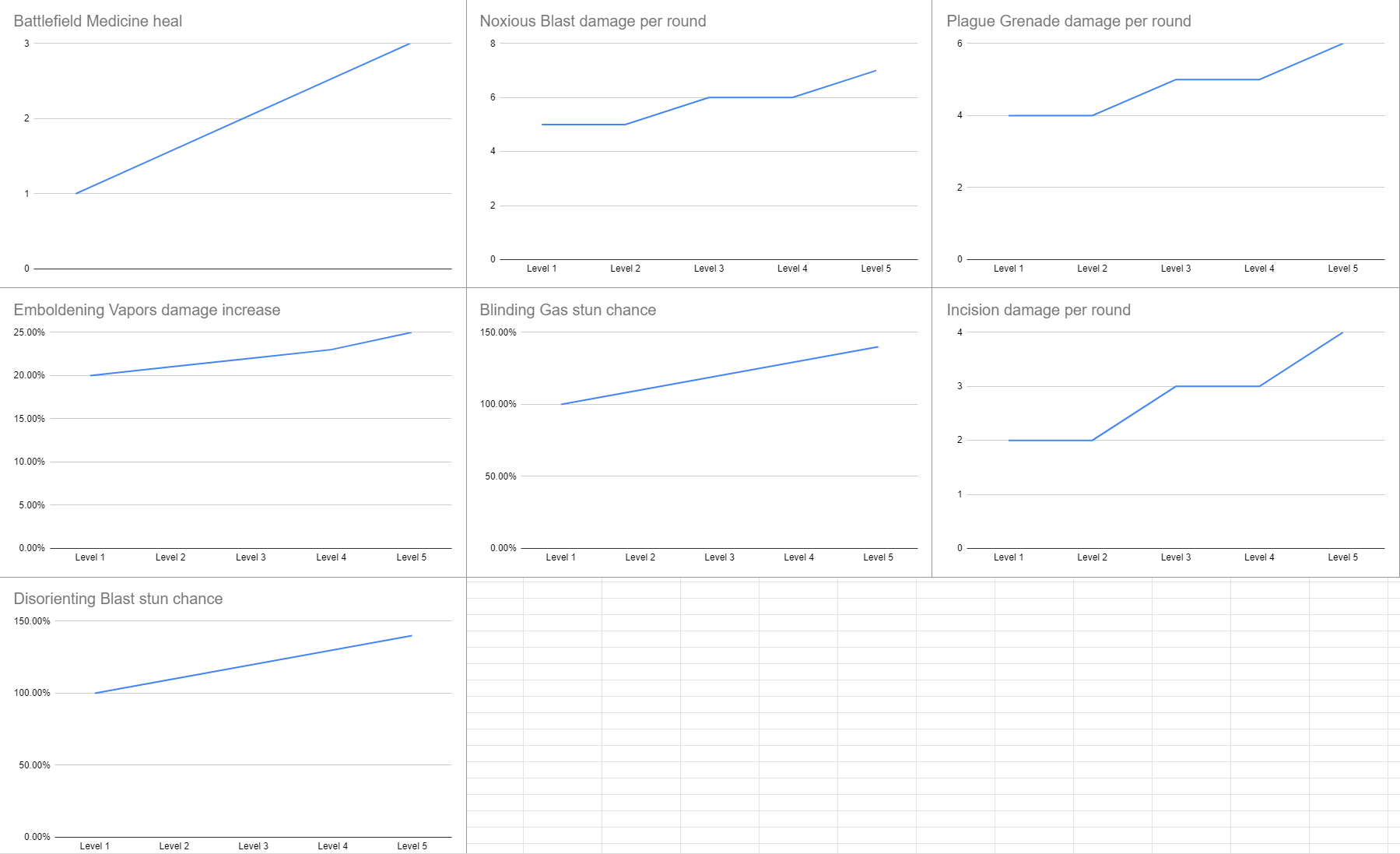
We can see that for example the Battlefield Medicine heal amount and the stun chance for both blinding gas and disorienting blast have a linear progression. Others have some plateaus but Emboldening Vapors is the only one that has a linear progression up until level 4 -> 5 where you get a 2% increase in the damage increase instead of 1%.
Unmatched - designing an expansion
I’ll be designing an expansion for the board game Unmatched throughout these posts in order to apply the concepts discussed in the future. For now, I’ll choose exemplars of balance by identifying under- and overpowered characters and finding the one’s that feel just right.
I currently own only 3 boxes so my character limitations are: Ingen, Raptors, Big Foot, Robin Hood, Medusa, King Arthur, Sinbad, and Alice. I’ll be basing my choices based on experience and partly on this great result tracker. I first grouped the characters and then checked the win rate to see how biased I am.
Overpowered
- Big Foot (60.2 % combined avg. win rate at time of writing)
- Medusa (60.7%)
Underpowered
- King Arthur (41.9%)
Balanced
- Muldoon (57.2%)
- Raptors (59.6%)
- Robin Hood (55.6%)
- Sinbad (61.0%)
- Alice (49.7%)
We can already see that I was clearly wrong about Sinbad and Raptors, but otherwise my intuition was alright in terms of the win rate. Starting with the overpowered characters: Big Foot has huge movement and cards that combine both damage and movement, making it easy to hit-and-run. Also, it’s almost impossible to escape from him as a ranged character even with multiple minions. He can most often walk through everything, nullifying the effect of the strategic placement of minions by the other player. Medusa has an insane card, Gaze of Stone. It has the possibility to do 10 damage! Even with a defense card it could easily deal 8. Furthermore, her passive is 1 damage flat every round if correctly placed. In other words, either you lose by attrition or you get nuked.
Underpowered characters: King Arthur. His ability is garbage. He could have the possibility to deal massive damage per turn but this is completely negated by the fact that the opponent can see whether you boost the attack before they decide to defend against it. Also, the opponent could just play a feint and make you basically discard two cards. In other words, the game is stacked against you since you need to play twice the cards your opponent does to get the benefit of the passive ability. Awful.
Balanced: Muldoon. Has some cool tactical moves with traps and his Ingen workers. Overall just feels that a lot of play involves planning way ahead with traps and triggering attacks at correct times. Raptors, low health per raptor, but combined is higher than average. Many of the cards are boosted by having all raptors alive so balancing between offense and defense is important. Raptors can be completely destroyed by Medusa, for example, with one hit so involves a lot of planning. Robin Hood, just feels good, not too powerful, not weak. Sinbad, surprisingly has the highest win rate of these characters. I thought he’d be more balanced in terms of win rate due to him having to ramp up. I feel like playing against Sinbad needs to be a slugfest or otherwise he will definitely be too strong in the end. Alice, feels completely right. Needs a lot of timing with changing sizes.