Game Balance: Systems
Systems are everywhere in a game and can be defined as a set of interconnected or interdependent parts forming a complex whole. Combat systems, leveling systems, skill systems, and so on are all systems that form the game. What they have in common are resources that either are system specific or shared across multiple systems.
In what ways is time integrated as a resource in a game?
Time is one of the most vital resources game designers should take into account. Time is a resource that the player invests into the game and the game needs to be enticing enough for them to invest. Also, time is a crucial component in designing the basics of the game such as how long should the game take. From this, a designer can induce how much experience should be given, how long should upgrades take and last, how often should the player be rewarded, and how long does it take to get the better sword, the next level, and so on.
Why might a game institute a level cap?
A level cap allows designers to design with a clear goal in mind. Let’s take for example an RPG where there is no level cap. How would you define how long that game should take to finish? How would you define how hard a boss should be? How would you create more content (and balance it) for the game if it would be an MMORPG? Instituting a level cap from the get-go allows the designer to design the progression curve as well as have a predefined state that they can design skill and stat systems around. For example, let’s say we have DnD ability scores of strength, dexterity, constitution, intelligence, wisdom, and charisma. We want a max level character to have their “main” ability score at the max, 20, and another “secondary” ability score at around 18-20. The rest could be in any number of configurations but we want them to have at least one poor ability score (<= 10) and the others should be in the range of 12-16. Now this allows us to design how often an ability score improvement should be offered to players on level up and how many points should be given.
Now we can also effectively design enemies for max level players since in DnD we’d also have an estimate for the total hit points of characters. Of course, DnD is a bad example in that you can play it any way you want without worrying about balance as long as a good story emerges from the play sessions, but the point is still that there are some underlying rules or progression curves that give designers the chance to design adequate challenge for players.
Sure there are great games with no level caps or seemingly without level caps. What I mean are soft caps - at certain point the benefits of leveling up are so minimal that they become almost irrelevant. This can also be in part achieved by making the experience needed for the next level spike hard making leveling very difficult to grind. This would still have the effect that at the end of the game the player would be in a certain level range unless they’ve dedicated an ungodly amount of time to grinding. Surely there’s no right answer to the question of whether a game should or should not have a level cap, it’s a matter of taste.
How are currency based economies integrated into games?
Currencies are present in a lot of games and I’d argue in the majority of games made. When talking about currency, a distinction between real-world currency and in-game currency needs to be made. Real-world currency naturally refers to actual money used in the real world for buying products and services. In-game currency is currency that’s used only in-game. Real-world currency can typically be converted into in-game currency with some exchange rates, for example, 1 dollar = 20 imaginary florent bucks.
In-game currency is also typically divided soft and hard currency. Soft currency refers to currency that can be reasonably acquired by players just playing the game without paying extra. Hard currency is currency that cannot be acquired or the acquisition rate is almost insignificant when adjusted for the amount of time used to acquire it.
Interestingly enough, time can also be a currency. Constructing a new building in your virtual village by waiting for twelve hours is a way of paying for the content with your time as currency. This also applies vice versa, currency can be used as a form of time. Some games might allow the player to speed up upgrades, research, construction, movement, or anything related to the game by paying for it with real-world or in-game currency.
What could you buy in a F2P game?
Free-to-play (F2P) games do not generate their revenue from selling copies of the game - that’s by already by definition in the name itself. F2P-games might allow users to buy certain content within the game, for example, vanity items, exclusive powerful weapons, access to more content, or just skipping or speeding up certain “grindy” parts of the game. League of Legends is widely popular and a very successful MOBA, but it is also F2P. With over 150 unique champions to choose from, players can grind their way through the game to unlock them all, but it would require an immense time investment. This article estimates it at over 9 years if you play one match every single day. Therefore, there’s an option to use hard currency to unlock champions and avoid the grind. LoL has executed this strategy with great success and avoided being labeled pay-to-win due to champions being arguably well-balanced and paying extra doesn’t really give you a clear advantage over the other team. Additionally, LoL allows players to buy emotes, skins, and other vanity which don’t have an impact on the actual game by adding damage multipliers or something of that sort.
Now let’s take another example: Tibia. Tibia is free and extremely grindy. Where it differs with LoL is that paying for premium membership has a VERY clear impact on the game. This could be very easily labeled pay-to-win. First and foremost, premium members get a +50% experience point gain boost. And in a game with virtually no level cap, premium members will always be ahead. Furthermore, you can promote your class to a superior rank, such as druid to elder druid or knight to elite knight. These promotions give you substantial regeneration bonuses to hit points or mana. Here’s a list of all bonuses paying members receive.
Thai boxing from a resource system perspective
Let’s try to break thai boxing down by examining its resource management system. Long before the actual match preparations are done by managing time. The coach and fighter both have to manage training time as a valuable resource thinking about balancing eating, training, and resting. Push a fighter too far in terms of training and they might be overworked. Give them too much slack and they won’t be prepared. Therefore, balancing these three elements and finding the perfect regimen is important.
During the fight the fighter must be aware of his own stamina and endurance as well as the opponents. You can’t go swinging away full blast since you’ll tire yourself out before the first round is over (assuming that the opponent is an adequate defender or counter fighter). The fighter needs to find the pace of the match and they can even strategically change the tempo from round to round. For example, the first round one could try to “feel” their opponent and try to learn their reactions and movements. After the round is over, the coach could have spotted a tell or a flaw in the opponents technique which they could then relegate to the fighter in their corner.
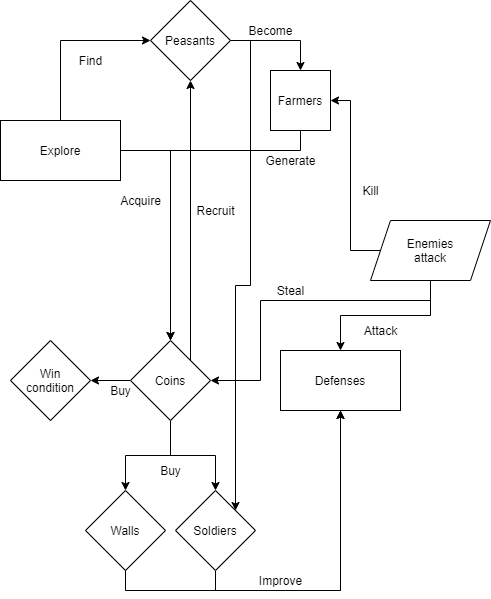
Small diagram of Kingdom: New Lands
Here’s a small system diagram of the game Kingdom: New Lands and how it looks like in a simplified manner.