Game Balance: Progression and curves
Progression in video games can refer to multiple different types of progressions such as character progression, narrative progression, skill progression, or mechanical progression. Let’s take Enter the Gungeon as an example and look at how progression works in game. Enter the Gungeon is a roguelite game where the player progresses through different levels in order to find a time machine (gun) that can kill their past. The game starts with a tutorial which goes through the game mechanics by introducing how to move, dodge roll, kick tables and barrels, how to use “blanks”, and how the game progresses from room to room. Some games might sprinkle mechanics throughout the game and introduce new ones later on, this would be called mechanical progression. On the other hand, mechanical progression in Enter the Gungeon comes in the form of introducing new guns that have unique effects. By playing the game and collecting these items the player learns that having certain unique items on them at the same time grant synergies and modify the weapons. Furthermore, the player meets NPC’s that allow the player to, for example, skip levels and gamble. So at the introduction level, the player is acquainted with only the mechanics of moving and interacting with the world but the world’s (or should I say dungeon’s) mechanics unfold through playing.
Character progression in Enter the Gungeon comes in the form of killing the character’s past and unlocking an alternative skin for them. There isn’t much individual character progression but narrative progression instead which comes in the form of going to each character’s pasts to understand what they want to kill from the past. The past also give a better understanding of their unique items they start with. Narrative progression in terms of the dungeon can also be identified as the character finds secrets and secret chambers in the gungeon. Lastly, skill progression is tested in the gungeon by introducing increasingly harder enemies and bosses that a completely new player might have troubles with. Similarly a player who has played the same levels through multiple times can also memorize what the bosses do and defeat them completely unscathed.
Identity, linear, exponential, and triangular relationships
An identity relationship is when one resource can be exchanged to the same amount of another resource - a 1:1 relationship.
A linear relationship is almost like an identity relationship, except that a linear relationship isn’t restricted to be 1:1 but can be for example 1:3, 1:10, 1:34983, etc. The only limitation is that the relationship stays the same. So if one is able to trade 1 gold for 3 apples, 9 apples must cost 3 gold.
An exponential relationship is a relationship that is typically multiplied a constant. Such relationships might be found in RPG’s when inspecting how much experience different levels require. Progressing from level 1 to 2 might take 100 experience points, from 2 to 3 it would take 200 xp, then 400, 800, 1600, and so on. So in this case we’d have a formula of 100 * 2level . Exponential relationships are going to go to high places crazy fast.
A triangular relationship is a series that follows the formula of y = (x2-x)/2. The result is a series that goes 0.5, 1, 3, 6, 10, 15, and so on. This is a useful progression when you don’t want the radical exponential curve nor don’t want a too linear curve.
Shared resources in different systems
Some systems might share a resource and the relationships in the different systems might differ. Let’s take gold in DnD 5e for example. You can use gold to buy items, housing, or use it as a component for certain spells. The 1st level spell identify requires a 100 gold piece pearl as a spell component. The 2nd level spell Arcane lock requires 25 gold piece worth of gold dust. Clearly the relationship is not dependent on the spell level but the requirements are custom. This is most likely necessary because the spells are very situational and defining a definitive relationship is extremely hard between different spells even disregarding spell level. Now if there would be just one spell in the whole game that would require gold and you could cast it using higher level spell slots that would add a set amount of damage per spell level it would make sense to have a linear relationship in gold cost.
On the other hand, if the dungeon master allows the players to purchase better gear (+1 sword, +2 armor, and so on) then the dungeon master guide book suggests 500 gp cost ceiling for an uncommon item (+1), 5000 gp for a rare (+2), and 50 000 gp for a very rare (+3). So between +1, +2, and +3 the cost multiplies tenfold - that’s an exponential relationship.
Monetization and curves
Let’s look at monetization in terms of the premium currency of blood bonds in Hunt: Showdown. You can use blood bonds to buy cosmetics and legendary hunters and blood bonds can be bought in packs:
| Blood bonds | 300 | 1000 | 2500 | 4000 | 5000 |
|---|---|---|---|---|---|
| Cost in euros | 2,99€ | 9,99€ | 21,99€ | 29,99€ | 39,99€ |
Blood bonds and the cost of the pack
It looks reasonable right? You’d imagine that buying bigger packs would save you more money as typically bulk purchases are rewarded in some way. Let’s look how these actually chart out
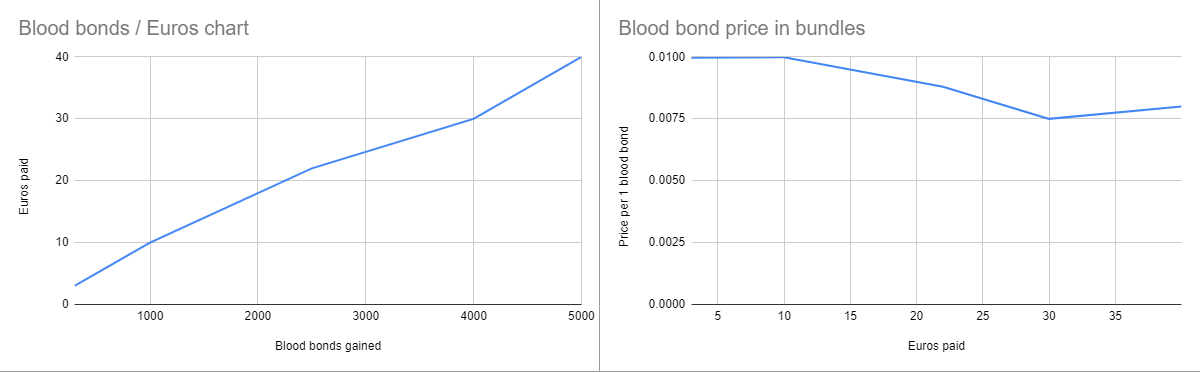
Woah, we can see that there’s neither a linear nor an exponential curve that we might expect. We see a custom curve that has something that happens in bad faith - the price of a single blood bond actually increases when purchasing 5000 blood bonds instead of 4000. This is predatory and game monetization designers do this on purpose since we’d expect this wouldn’t happen.
Why would you implement spikes and valleys in curves?
Sometimes you might come across a super powerful weapon in a game or some ability that feels way overpowered compared to how you have progressed this far. Game designers might intentionally place these spikes to award the player for advancing so far, for example, and give them a satisfying feeling of power. This could be temporary and they could ramp up the opponents once again later but let the player enjoy being a demigod for a while. There might also be valleys in curves for multiple reasons, but one that comes to mind is to push the player to invest more in something in order to cross that valley. For example, you could buy a basic gun for 150 gold which deals 80 damage, a gun of awesomeness for 300 gold which deals 100 damage, or a gun of absolute madness for 350 gold which deals 150 damage. This would mean you could by the highest damage for only 20% more gold than the second best and get 50% more damage - now that’s a good deal!