Game Balance: Finding an Anchor
An anchor in this context is a number or attribute that other numbers can be based on - it is directly related to all other numbers. The anchor typically represents a central resource that might be shared across different systems. In an RPG, such an anchor is typically hit points due to it being a resource that is affected either directly or indirectly by multiple components, such as armor, enemy attack damage, experience level, character stats, buffs, nerfs, and what not.
Let’s look at Darkest Dungeon. I would argue that hit points are the anchor of the game. There are items that provide stats, both positive and negative quirks, diseases, resolve levels, status effects, heals, attacks, camping skills, food, torchlight, and stress. Why hit points is the anchor of Darkest Dungeon is because every single of these abilities or mechanics are directly related to hit points. Items that provide improvements to a character’s offense allow them to dispatch enemies faster and thus preventing enemies from dealing too much damage and the character losing hit points. Items that provide defense improvements allow to mitigate the damage dealt by enemies. Positive and negative quirks follow the same logic. Resolve levels improve the chance of gaining a virtue when the character reaches their breaking point in terms of stress. Stress is sort of like an inverse hit point gauge that starts from 0 and once it hits 200 the character will get a heart attack - hit points go to 0. If you hit another heart attack threshold, you die.
But what about a game without hit points? Let’s take Chess - what could be it’s anchor? I’d argue that the anchor of Chess is the size of the board (8x8). The movement of the pieces and how many pieces can be placed on the board to still play in a reasonably sane way can then be derived from the available space. For example, look at the Japanese game of Shogi which has a 9x9 board. Just one column and row more and one more row of starting space can be added to both players without the board being too crowded.
Not having a proper anchor or choosing the wrong anchor might present many issues in designing a game. Imagine designing weapons for a game without taking into consideration their effectiveness in combat. If you want, for example, extremely rare and high damage guns in the game but have forgotten to balance the lower tier weapons accordingly so that the lowest tier weapon already one-shots every enemy - what’s the point of going for a higher damage gun? Same goes for another situation when the worst gun deals 1 damage and the best gun deals 100 but the enemies have a googolplex of health. Gunning down an enemy would probably be taking so long as to bore the player before they get even one kill.
Granularity
Granularity in game design refers to the proximity of numbers in relation to one another. So if the first sword an adventurer gets in the game deals 1 damage and the absolute best sword of the game deals 10 damage, then the designer is confined in between these two numbers. You could make swords two-through-nine and now you have 10 swords in your game. Compare that to the first sword dealing 1 damage and the best dealing 100. Populating the numbers between with swords you’d end up with 100 unique swords just based on the damage number alone.
When numbers are close together, it is referred to as low granularity. The opposite, high granularity, is also not ideal if you have a sword dealing 9 999 999 999 999 999 999 999 and another sword dealing 9 999 999 999 999 999 999. It’s quite hard to tell the difference but rest assured, there is a difference. At these levels the low end numbers also become irrelevant.
The anchor in Sonic the Hedgehog
Here’s a small diagram depicting the resources in the classic arcade game Sonic the Hedgehog (1991). The point of this is to demonstrate how to find an anchor in games.
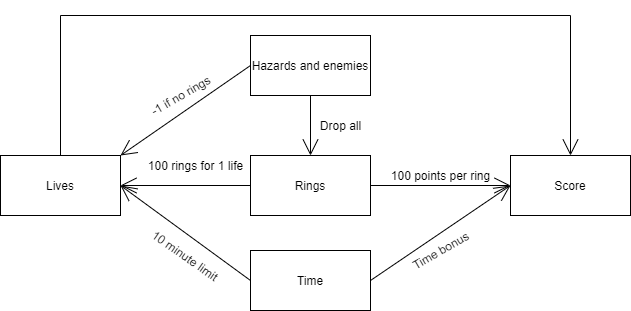
We can see that everything points to Score either directly or indirectly. Therefore, Score would be an excellent candidate to use as an anchor for the game and designers could gauge the other numbers in terms of Score. How many points per ring, how many rings to put on a map, how much should the time bonus be. You might be wondering why Lives is pointing at Score. That’s because lives are exchanged to play the level and essentially increase one’s score.