Game Balance: Trading Systems
There exists a vast variety of different trading systems as well as auction systems in games. Trading can be made safer by implementing a trading window in which players need to show what they are trading and both parties need to agree to the trade. Here’s an example from Diablo II.
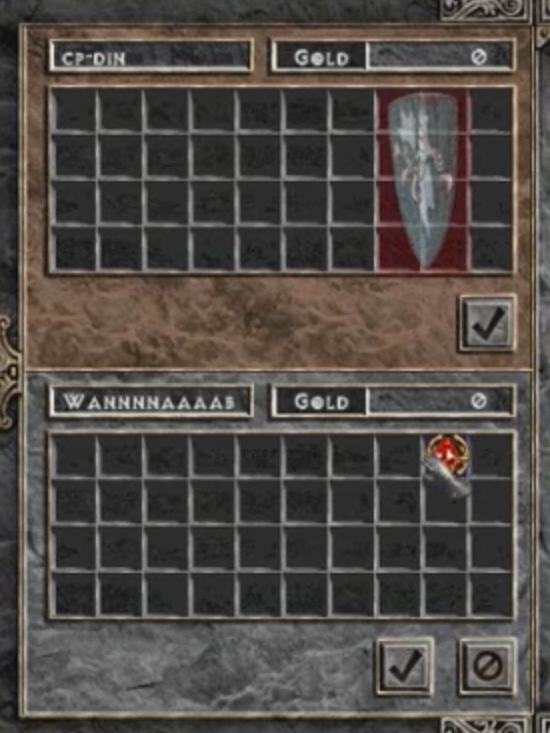
Diablo II trade window
Although, Diablo II had a problem where the trade window could be exploited and items up for trade were not actually being transferred to the other party and thus the scammer could receive the counter-offer and keep his own item. An alternative to trade windows, which are quite common in some form, is to have no trade windows and players trading by other means - usually involving trust. Sometimes players are also forced to trade without trade windows such as when trade limits are in place preventing conventional trading. Players can then drop trade, meaning that they just drop the item in the game world and expect the other party to do the same with the counter-offer. There’s an element of risk here that once you drop your own item and the other player does not reciprocate and just snatches the thing you dropped, you’re out of luck. Game developers typically state that all trades within the game are done at the player’s own discretion and bypassing the trade window is not their concern. Another form of trading that I remember was done via in-game mail in Tibia, a F2P (more like pay-to-win) game that I played way way back. Typically mail trading was only done with players you knew out of game or players you had developed trust over time. This would include just mailing the items directly to the other person expecting that the other player will mail you their share of the trade as well. Here there was also no guarantee that the other player will hold their end of the bargain.
These examples of trading are just about virtual games and these don’t apply to analog games that well. Analog games might have rules to enforce trading instead of trade windows, but some analog games also have very light rules on trading and there’s room for backstabbing as well. Such is the game of Risk where you could potentially “trade” with the another player by assuring you won’t attack them if they are also willing to not take up arms against you. This is not in the rules and both players could immediately break this truce and backstab their friend. Some games are like this by design and require backstabbing in order to win.
Auction systems
Just like trading systems, there exists a variety of auction systems from silent to Dutch auctions, but the most common of them are open auctions. These are auctions in which the seller puts up an item (can also be a bundle of items) for sale and the bidders call out bids in any order, always bidding a higher bid than the one previously offered.
Implementing an auction mechanic in a game allows game designers to bring more layers for players to strategize. Depending on what the game designer wants, they can implement the auction in multiple different ways which all may have a different impact on game balance. If, for example, everybody has only one bid they can make instead of an unlimited amount, this will make the bidding phase extremely tense since you don’t want to waste your bid especially if there is some cost to it. Of course, the implications of implementing an auction mechanic might not only be positive since auction mechanics can lead to kingmakers, meaning some player who is hopelessly losing, doesn’t care, or just out spite makes a ridiculous bid for whatever it is in order to give an overwhelming advantage to the one who receives the bid. This could be averted by making the “bank” be the auctioneer and the auction could work as a negative-sum mechanic in the game economy.
Limited information in trading
I earlier mentioned that trading can be done with trade windows or drop trading. In these trades the players both know what is being traded, but what if one or both players have limited information of the trade? In the German children’s card game KuhHandel, the second phase of the game has players putting animals up for trade. The trades are done so that both players know what animals they will receive if they offer more money than the other player, but also both players keep the money that the other player put up for trade. In essence, both are trading money for animals and you could also call this some form of auction, but in this case both players would be the seller as well as the buyer. It’s interesting how much of strategy is involved in this phase of the game as this is still a children’s game after all. You have to think of how much the other player wants the animals, are they going to offer high or low, and how much you can afford to offer and still stay in the game. If you offer too high and the other player offers literally nothing, you have lost a lot of money and now all other players may force you to trade with them, knowing you can’t afford to even put up money.
Encouraging and discouraging trade
Just providing the mechanics for trade might encourage players to trade but what would be the case when players are not interested in it? This could be in the case where resources are abundant for all players and therefore there’s really no need to trade. A simple way to encourage this is ensuring resource scarcity. Other players having what another needs encourages them to engage in trading. But game designers might not always want to encourage trading, but rather discourage it. For example, World of Warcraft has had gold farmers and bots that allow players to purchase in-game gold for real world money, causing inflation in-game due to money being added to the economy. Sometimes trading might be discouraged also to avoid scams happening and protect the player. This could take form by adding items that cannot be traded to others, imposing limits to trades (amount of money, trades per day, or similar), or adding restrictions for the use of an item, such as class or level restrictions.
Trading vs. Gifting
A trade happens when two players both offer a resource they have to be exchanged for the counter offer that the other player has put up. This is called trading. Gifting is when one player gifts a resource they do not possess to the other player without the necessity of reciprocating. A distinction is to be made here that a player can accept a trade where player A offers 100 gold and player B offers nothing. This is a trade since player A has previous ownership of the resource they are trading. This can be confusingly enough understood as a gift but it’s common especially in F2P games to use the term gifting for another purpose. That’s why these distinctions need to be made. Like mentioned, gifting is most typically seen in F2P games where players have a certain quota of resources they don’t own that they can gift to other players. They don’t lose anything by gifting while the other player gains those resources. Typically the gifting party expects the other player to reciprocate though and might not send any more gifts if they don’t. Gifting is typically done with resources that might be hard to come by using other means, such as grinding. This leads to players expanding their social network in order to receive more gifts and they might also recruit their real life friends to play the game for further gifting.
Hypothetical auction design
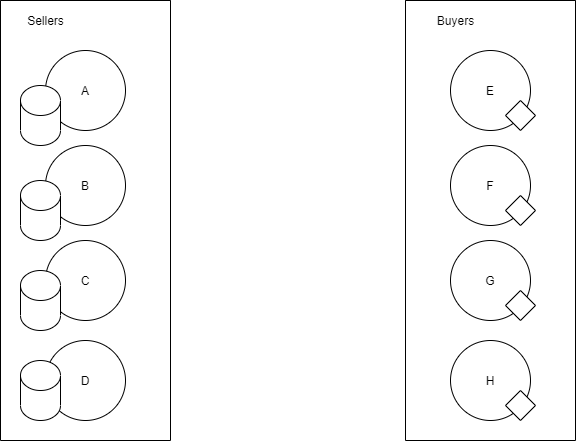
Let’s design an eight-player auction phase in a game. The game context doesn’t matter that much, just the auction phase and auction mechanics. Let’s assume that we have 4 sellers and 4 buyers in the auction phase. The sellers all have one resource of a different type, for clarity’s sake we’ll say seller A has a rock, seller B has a stick, seller C has a bottle of water, and seller D has a fish. We’ll assume that each of these resources is perfectly balanced in terms of the winning condition, as in a rock does not grant the owner of the rock a clear advantage over the other resources. The same goes for all other resources.
We’ll make some assumptions about the buyers as well: they all have the exact same amount of bargaining chips. Let’s say all buyers, players E through H, have one hundred diamonds that they can use to bid on resources.
Here’s how the starting situation looks like:
Now let’s start implementing some mechanics of how the auction phase works. The first step in the auction phase is to determine what is being sold. This is determined from the order, the resources put up for sale are first the resources of A and D - the second round will be B and C. Buyers will place their bids for the items and the top two bids will be winners - both getting one of the resources on the table respectively. The one who has placed the second highest bid will be the one to choose the resource they want first and the highest bidder gets the second resource. We’ll assume that these resources may affect the game strategy they play but we are currently ignoring that so there’s probably some considerations about which resource they’ll want to take. The losing bids are given back to the respective bidders. This step will look like this:
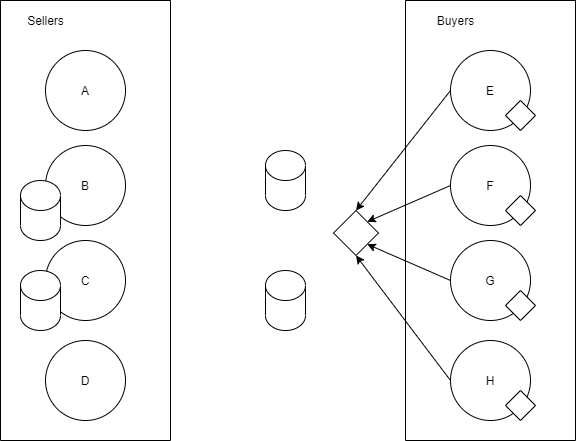
Once the winners have taken the resources they want, the diamonds are split among the two auctioneers 50/50. Then the second round comes and goes just as the first round and all resources have been auctioned. Some buyers might have two resources and some might have nothing at all. The diamonds left for each buyer will most likely differ and sellers may or may not have the same amount of money.
Now let’s analyze what components this auction has. This is clearly a silent auction with an element of strategizing to underbid the biggest bid and still maintaining a high enough bid to stay in the top two bidders pool. The payment style of this auction is winners pay to avoid them getting resources AND their bid back. This is a multiple item auction with a variation of an item draft mechanic in it, by not giving the winner the first choice but grant that choice to the second highest instead. The auction also includes an equal payout for the sellers. Could we put all of these into a cool sounding auction design? Of course. Multi-item winners-pay silent auction with a reverse item draft. Excellent.