Game Balance: Character Builds
A lot of games throughout different genres have character builds in one form or another. This can be manifested by either the class, race, equipment, abilities, stat points, or some other character related attribute that I didn’t list here. Typically though, a build isn’t just one thing but rather a holistic abstract encompassing all or most of the attributes. In Path of Exile the idea of a build is very concrete since the game relies heavily on equipment loadouts with the option of making numerous unique combinations. Games such as Path of Exile that have a wide variety of builds typically tend to have an online community posting, ranking, and discussing builds. Builds typically can be thought of as optimal or min/maxed, viable, and non-viable. Optimal builds are just that - optimized. They are designed around playing to the strengths of the character usually “dumping” other unnecessary or irrelevant stats. Viable builds are builds that can be played to complete or play the game without having too much of a hindrance whereas non-viable builds are thought of as useless. A non-viable builds refers to a build that in a PvP game has no chance of being competitive and in a PvE setting has little to no chance of surviving.
In Diablo II for instance the player community has quite strong opinions on what are the god-tier builds vs. non-viable builds. Of course, different builds might be meant for different purposes, as in the case of Diablo II where builds are generally categorized into leveling, magic find, pvp, or boss killers. Here’s an example of builds ranked to tiers on rankedboost.com:
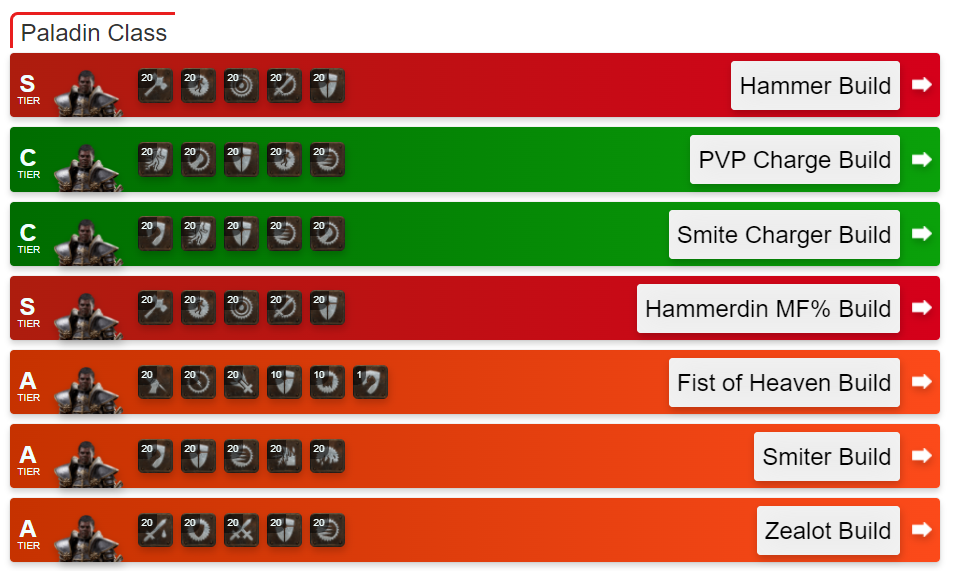
Although different builds might be optimized with different goals in mind, some builds might come on top in multiple categories. If this is the case, it might be an overpowered build. An overpowered build is a build that nearly completely guarantees success or victory with correct play regardless of what the build faces. Some games might not have such builds even though players are complaining that something is overpowered. In fact, these might be balance issues from game design perspective but it might also be that the players are just playing the worst way possible against such a thing.
Anyway, here’s one example of a truly overpowered (even broken) build in Dungeons and Dragons 3.5th edition: Pun-Pun. You should read it a bit just to see that there does exist completely broken builds, although Pun-Pun might be a bit controversial since there’s the case of intentionally failing a save that goes slightly against the rulebook. How should game designers deal with such builds? What could they do against these?
If there exists a truly overpowered build in the game, it’s a design flaw. This could be the result of stacking modifiers due to oversight of the possibility of combining them. If the designers wanted to have, for example, a sword that “doubles your damage” and disregarded that there’s a possibility for someone to dual wield these and basically get “quadruple your damage”, it could lead to problems in balancing the game out. Item or ability combinations might have unintentional synergies that result in overpowered builds especially if items are dependent on each other. A way to circumvent having exponential stats is to base modifiers on some base value or have them add flat amounts. This way you can keep the power curve more linear and ease out balancing the game. Having overpowered builds is a problem, but so is having completely non-viable builds. Let’s say a player really really wants their sorcerer to only do fire damage and that’s an option that the game let’s the player choose. The end boss is immune to fire damage - what now?
I enjoy playing D&D 5e and thoroughly like to experiment with novel builds. Even though combat is an essential part of D&D, it’s completely viable to play a pacifist in game assuming that you have a damage dealer in your party or that the DM allows conflicts to be solved without violence. Such options of play allow for players to make meaningful choices and give players the feeling of agency over how they play the game.
Gods and dumps
There’s a really good GDC talk about stats by Josh Sawyer available here. A god stat refers to a stat that is necessary for optimal or in some cases even viable play. Let’s say that your ability to hit and deal damage is completely based on your strength score - if you fail to put any points into this stat, you can’t hit anything. Therefore, it’s not even a meaningful choice since you really have to focus on putting stat points there. The opposite of a god stat is a dump stat. A dump stat is something that can be safely ignored without it having a significant impact on gameplay. Let’s say there’s a luck attribute that just makes it more probable to see flowers growing on the ground but nothing else, you can safely ignore this stat unless the game is dependent on seeing flowers growing somehow. If you’ve got a god, dump, or both stats present in your game, it’s a sign of imbalance. Players should be given meaningful choices and thus game designers strive to make stats and attributes at least marginally useful to everyone. If you don’t have even marginal use for a stat, why even present the possibility for the player to choose how to distribute their stats?
Overpowered vs. non-viable - what’s worse?
Ian Schreiber and Brenda Romero present a question in their book Game Balance:
“Which would be worse: shipping a PvP game with ten character classes where one of them is entirely nonviable, or where on of them is extremely overpowered?”
This is a tough one. A completely nonviable character will never probably be played except as a joke whereas the overpowered character will most likely be played a lot and overwhelm all others. An overpowered character could be just banned from tournament play and thus also be never played. Both scenarios lead to basically having 9 playable characters, but I would still say having an extremely overpowered character is worse. Overrepresentation of that character in matches would be obvious between competitive players and the 9 other characters would surely not be played that much. Having one nonviable character would be better since the other 9 characters could all still be used, offering players multiple viable options for winning rather than just playing the most overpowered character.
Progression and builds
I already touched on this topic by mentioning that designers should give players meaningful choices and without those it might be pointless to even present options to the player. Although, it doesn’t mean that all choices must be equal and it might even be difficult to design something where every single choice is equal. Descent: Journeys in the Dark 2nd edition has some pretty interesting progression. There is a possibility to optimize builds for characters by playing to the characters strengths but there really isn’t a non-viable way to build a character. You are presented with skill points that you can use to buy different skills as a sign of progression as well as gold to buy equipment. All skills are viable and useful throughout the game whereas equipment also is generally useful. This is also due to stats being stats being static and only affected by equipment or temporary buffs.
Generic three attribute system
Alright, let’s try to design a very simple character build system. This system will have three attributes and typical roles in this hypothetical RPG will be support, tank, and DPS - very standard. How should we go about designing an attribute system while avoiding god and dump stats?
Three attributes, we’ll call them Power, Speed, and Insight. If we’d go along with the typical Strength, Dexterity, Intelligence or Constitution, Dexterity, Arcane, or something of the sort, players would most likely expect that each class has a god stat, namely constitution for the tank, dexterity for the DPS, and arcane for the support. It’s not good practice to completely thwart player expectations and players might feel frustrated due to nonstandard attribute effects. Right, so back to Power, Speed and Insight. We’ll have to make these three be useful to some extent to each of the classes. How we do this is by tying the base value of health, defense value, damage, and so on to gear - not the attributes. Then we give the attributes, well, attributes that can be useful to some degree to all classes and try to avoid clear god or dump stats. I’d suggest something like this:
Power - Each point of Power increases your critical strike damage by 1% and reduces the damage of critical strikes against you by 1%
Haste - Each point of Speed increases your casting, attacking, and dodging by 1%
Insight - Increases your chance to critically strike by 1%
Now each attribute would be beneficial to even the support in terms of healing and getting a critical strike. These could be further made useful by making abilities have unique properties when critically striking. A tank otherwise might not put points to Insight since their main job is to survive and soak up damage. But if, for example, every time they critically strike they stun the target it would be worthwhile to invest some points into critical strike chance.