Game Balance: Combat
The majority of games I play have combat as an integral part of the overall design. There do exist a lot of games without combat but I’ll be (maybe) covering those games in some other post.
When designing combat, one can’t be vague about it. You can’t just say “The player has a sword and he’ll kill enemies with it”. This already raises a lot of questions about combat, such as: What kind of a sword? What are it’s stats? What kind of attacks can the player do with the sword? What kind of enemies will he kill? Will there be different types of enemies? Will the enemies attack back? And so forth. This is where a lot of math and numbers come into play. As we’re concerning ourselves with game balance, it’s important to make the combat balanced as well. This definitely doesn’t mean that player death or failure means the combat is unbalanced. Balanced combat can be found on the threshold of too easy and too hard. A designer must create the illusion of winnability and threaten the player with consequences for failure. If a player perceives the game to be too easy with no real threats, then what does it even mean to achieve victory? You won by design. If you overcome obstacles and manage to barely slip away from the cold clawing fingers of death, then victory is meaningful, an achievement.
When combat is balanced, both sides can become the victor. This means that combat is unbalanced if from the get-go one side is sure to lose. This does not mean that because someone countered another players strategy or character that combat is unbalanced. Both players should have counters and even possibly counters to counters. This adds to the illusion of winnability by shifting the focus from “wow, I lost because there was nothing to do” to “wow, next time I need to counter that with this”. If the player blames themselves and not the game, it’s a good sign that at least players might feel like combat is balanced.
Furthermore, combat balance relies heavily on cost and power curves that I’ve gone over in earlier posts which I won’t reiterate here.
Aesthetics matter
On top of good combat being balanced numerically it needs to feel balanced. This means that the sounds, looks, and the visual effects on impact need to feel that they are corresponding to player expectations. Same goes for victory celebrations and the timing of combat - they need to be just right for the combat to also feel good. Just look up some of the gunplay on DOOM / DOOM Eternal and it just feels amazing. The light sway of the guns while moving, the sound the gun makes while shooting, and the impact effects are just great. The point of the game is to make you feel like a demon slaying beast and it works. Then looking at Halo Infinite, for example, the guns don’t feel as impactful as in DOOM but still feel quite right. One gun in particular is interesting: the plasma pistol. It looks small and the sound it makes when firing the basic shot feels like you’re shooting with a toy gun. This always felt just bad overall for me. Now if you charge it up, the guns starts to shake as well as the camera, there’s added visual effects on the gun and feels like you’re holding back something truly powerful.
What if Pokémon was pure combat or had no combat at all?
There exists some games that are almost entirely made of combat with some other elements, e.g. puzzle solving (like DOOM). A lot of RPGs have combat as one pillar of the game but typically have a lot of other aspects of gameplay as well. Pokémon is a game that has combat as an integral part of the game loop but has a lot of other features in the game as well. You meet with lots of NPCs, you explore places and find items, you can decorate your house or secret base, there’s downtime between combat where you go to a Pokécenter to heal your pokemons up, etc. Now what if Pokémon was almost purely combat? Meaning, what if the game would go from combat to combat without almost any exploration? We could switch up the game so that after every combat, you’re pokemons heal up and gain back their moves so that you can start the next combat straight away. We could incorporate decoration elements by getting them as loot from defeated pokemons and you could decorate, for example, the GUI, your pokemon, or the battlefield. For the game to still be appealing we’d need to add all kinds of flare and extra supporting content around combat, just like fighting games have skins, ranks, and titles. Taking away RPG elements would require us to compensate and add more stuff to combat.
If Pokémon would have no combat at all but just exploration, we’d need to compensate the other way. We’d need to expand the other way and enhance exploration, make bigger and more difficult puzzles, add more intrigue to the world by adding more activities and having depth in those activities.
Combat pacing and variety
Let’s compare some games and their combat pacing. I’ll take into comparison games that I have played and know of: Enter the Gungeon, Hunt: Showdown, and Left 4 Dead.
In Enter the Gungeon combat is frequent but swift. A round of combat starts when you enter a room and for the first floor typically takes around 15-30 seconds if you know what you’re doing. There’s minimal downtime, typically the next room being started within 5-10 seconds of clearing a room. Sometimes though there’s a chest room which then soaks up another 5-10 seconds. Backtracking from a dead end also takes some time but due to teleporters I’d estimate that to be 5-10 seconds as well. This means that Enter the Gungeon on the first level (“chamber”) is about 50/50 divided between combat and downtime but it fluctuates between them very rapidly. This is excluding a boss fight of course and some NPC interactions. Furthermore, even though chambers get progressively more difficult so does the character get progressively more powerful with more weapons and items. Now for variety, Enter the Gungeon has five official chambers that all introduce new enemies. There are also some secret levels and special enemies that might appear every now and then but the main point is that new enemies are introduced and every chamber is cleared in about 10 minutes (again, if you’ve played the game before). Overall it’s very high intensity bullet hell type of game but the the 50/50 split between combat and small breaks to catch your breath feels well designed.
Hunt: Showdown has a 60 minute window of play with 12 players per server chasing the bounty of one or two boss monsters. Zombies and special infected enemies are scattered around the map and make just running through the game difficult without attracting the attention of enemy players. These zombies are scattered mainly to all encampments in the game but also some in between. The distance between encampments varies but typically neighboring encampments are about a 1 minute journey away. On the other hand, boss combat takes a relatively long time if you don’t have sticky bombs or a bomb lance to finish them off quickly. Boss combat with three people generally takes around 1-3 minutes. So chasing clues for at least 3 minutes (you need 3 clues located in encampments) and either avoiding or clearing the zombies there takes another 1-2 minute per camp you’re looking at about 10-15 minutes of exploration. Then fighting the boss takes about 1-3 minutes with significant downtime in waiting for it to banish and you being able to collect the bounty, you’re looking at a 1:5 ratio of combat to exploration. Sure clearing out zombies is combat as well but it gets pretty monotonous after playing the game for a while. This ratio can completely flip with the introduction of enemy players. Sometimes you are in combat for minutes on end, hell I’ve been in combat for 15 minutes on several occasions. This is because some players try to be very stealthy or are just waiting for a head to peek around a corner. Then the ratio becomes more close to 50/50 but I would say that I’ve definitely spent more time out of combat than in combat in the game, because combat can very quickly be over due to player characters being very fragile.
Left 4 Dead has a pacing closer to Enter the Gungeon than Hunt. You walk for a while, activate something and then clear out the horde you have just attracted. Combat ranges from very quick to several minutes. But in between those several minutes there’s typically a moment between waves of hordes, allowing players to heal, stock up on ammo, or pick up items. I’d say from a gut feeling that L4D has more combat than downtime but more like 70/30 not 90/10.
I know it’s not completely alright to compare the games based on Metacritic but anyways, Enter the Gungeon has a Metascore of 84 and User Score of 7.9. Hunt: Showdown has 81 and 7.2, and L4D has 89 and 9.0.
Combat pillars (with two examples!)
Ian Schreiber and Brenda Romero list the pillars of combat to be the following:
- Genre
- Time
- Pacing
- Feel
- Participants
- Progression
- Volume
All of these pillars are equally important and should be considered when designing combat. Genre defines the space in which your games combat takes place and what expectations players might have. Players that have played similar games in that genre do have certain assumptions about how the game progresses and thus these assumptions should be taken into consideration. The time component addresses how combat progresses relative to time, i.e. is it real-time, turn-based, or some sort of hybrid or novel approach. Pacing refers to whether the combat is fast-paced, methodical, calculated, tactical, or something of the sort. For example, if you think of Chess as a PvP game you can definitely say that the pacing of the combat is methodical, calculated, and pre-planned. Then you take something like Mordhau or Chivalry where the combat is very fast-paced depending on the game mode and mayhem is a constant. Feel is what you want the players to feel as they enter and are in combat. In Devil May Cry or DOOM players might feel a sense of flow whereas in a game like Hunt: Showdown or Resident Evil you feel anxious and the mood is tense. Participants is referring to whether combat is one-on-one or squad- or team-based. Is it something else? Same goes for who is participating in the combat - is it the AI, is it the players, or is it both and against who? Progression touches on how one gets better and progresses in combat. Some games like Tibia have character-based progression meaning better performance is relying heavily on the character gaining levels and power whereas the alternative is something like Counter-Strike: Global Offensive where the players hard skills like aiming and reaction time are much more significant than the gun they use. Volume refers to what the combats volume is in the context of the game. Is combat the game or is it just one part of something larger? Take Civilization games where combat does play a part but not to the extent is plays in, let’s say, Mortal Kombat.
Let’s analyze two games using these pillars, Into the Breach and Total War: Warhammer.
Into the Breach
- Genre: Strategy
- Time: Turn-based
- Pacing: Calculated
- Feel: Tactical
- Participants: Squad-based Player vs. AI
- Progression: Character Progression
- Volume: Combat is 2/3 of the game, managing the squad and doing missions is 1/3
Total War: Warhammer
- Genre: Real-time strategy, Empire building
- Time: Real-time (with pause option for PvE)
- Pacing: Intense but pre-planned
- Feel: Coordinated
- Participants: PvP or PvE
- Progression: Mostly player progression but partly character progression
- Volume: Combat is only 1/3, empire building and unit management is 2/3
Implementing combat to Trivial Pursuit
Let’s try to implement combat to a classic roll-and-move game: Trivial Pursuit. First, let’s think about how we want combat to feel. For a game like Trivial Pursuit that requires a good amount of trivial knowledge, I’d want combat to be about knowing your opponent as well. Combat should be chosen wisely and thus refraining from combat should also be a tactical decision. Combat should initiate only when the player moving chooses to do so and combat would start only when passing or landing on the same tile as another player. For Trivial Pursuit, the goal is to gather all of little pieces for your pie of knowledge to prove that you truly are the pub quiz king or queen. Therefore, combat in the game should be incentivized by giving players the option of choosing combat over one of the pieces the other player has. Conversely, if they lose the combat, the defender gets to choose one piece from the attacker. This would put some penalty on initiating combat against someone.
How combat in Trivial Pursuit should works is simple. After moving at least one tile and once you are on the same tile as another player, you may end your movement there and challenge them to battle. The attacker must announce what colour piece they want from the defender and that colour also defines the category of combat. The combat starts by asking both the attacker and defender separate questions from the chosen category starting from the attacker. The one who first gets the wrong answer loses. If the attacker loses, they must forfeit one of their pieces chosen by the defender. If the defender loses, the attacker gets the piece they chose at the beginning of combat. Combat cannot be initiated if either the attacker or defender do not have at least one piece. Note that combat can only be initiated after moving at least one tile, meaning two players can’t be attacking each other on both of their turns.
Designing variety in combat
In a 60-hour RPG that is one third combat and two thirds exploration and other things, how many distinct enemies should we have? Typical combat takes 2 minutes and boss fights more.
First of all, we know that from the total 60 hours about 20 hours will be combat. Within this 20 hour window we will be fitting 600 combat encounters ((20*60)/2). How I would go ahead from this, would be to think about the intervals of change. How often do we want to change something about the enemies? If we have 2 minute combat sequences, I would want boss encounters to take a bit longer, let’s say 5 minutes. How I would do it, would be to have combat encounters separated the sections. We’ll agree on 10 unique bosses sprinkled so that we have the bosses in a triangular curve to be on combat encounters number 10, 30, 60, 100, 150, 210, 280, 360, 450, and 600. This leaves the last boss a bit further than the triangular curve would allow but it makes each boss appear after greater endeavour. Now we need to design distinct enemies in the normal encounters. We’ll start with basic thugs for the first few combats. Just thugs with clubs, simple and effective. After a few combats we change one of them to have a spear then add and archer, a shield, a sword, some better armour, more muscular thugs, faster thugs, and so on. We’d get at least a thug with a club, a spear, a bow, a shield, a sword, and armour - 6 distinct enemies so far and we could have these repeat for the first 60 encounters in different varieties. Tweak their speed, strength, health, numbers, and AI behaviour in terms of aggressiveness. Then start adding something new for our epic RPG - monsters. The thugs have employed goblins who also have a club, a spear, a slingshot, or a dagger - 4 distinct goblins. Tweak the same things and mix and match the thugs and goblins. From having 6 thugs and 4 goblins we can already form 252 unique combinations of groups of 5 enemies - impressive! We could probably repeat this until we hit the 200 combat mark, still having 140 unique encounters. Then before the 210 mark boss we add a monster hell hound the goblins have trained. After the boss we add orcs who only wear full armour and a battle axe. Now we have 12 distinct enemies with 10 unique bosses. With 12 distinct enemies we can have 792 combinations of 5 but of course we would be varying the number of enemies in combat as well. Such as 2 orcs + 1 goblin, 3 goblins + 1 hound + 1 thug, and so on. With these enemies we could go all the way up to the end boss and not have the combat turn out dull due to tweaking weapons, behaviours, health, speed, and damage.
Creating a new mechanic for Unmatched
I listed all cards that are shared at least between two decks, listed their values, their special effect type, when the special effect happens, and assigned values for the card types as well as special types. I tried to find some balance in assigning the values and checked whether I could create a somewhat reliable system to classify whether a card is overpowered, balanced, or underpowered. What I got from this was this graph displaying the cards “balance value”. It was calculated by summing the value, type value, and effect value and substracting the “base” value of a card which I determined to be 6. Then we get all cards to be close to 0 except Regroup which is -2.
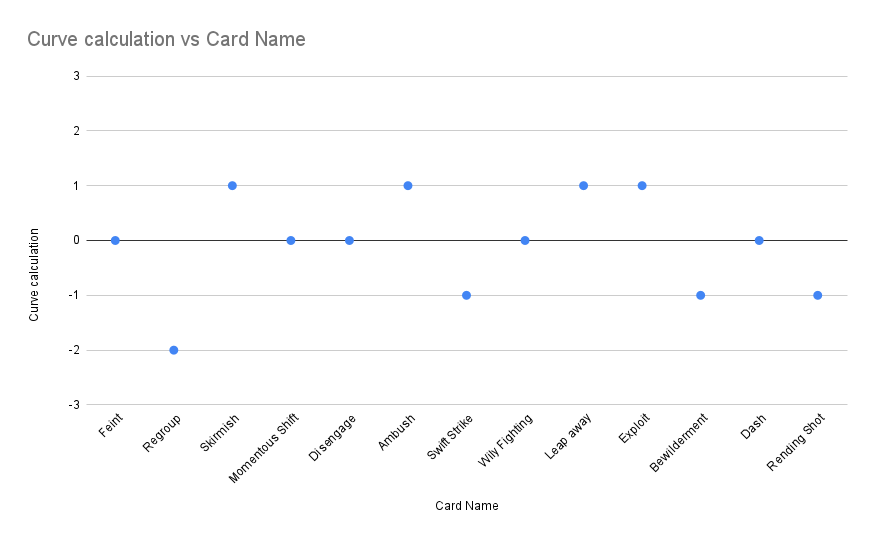
Card balance values
Here’s the supporting data I gathered with values assigned to card types

I then came up with a new mechanic for the game and tried to incorporate it into the game.
Fatigue: Every card has a fatigue value that indicates the toll on the character playing that card. Hard hitting special attacks are extremely heavy to perform and therefore induce more fatigue. If a characters accumulated fatigue is over 6, it must spend it’s turn only on maneuvering or scheming. Some cards may have negative fatigue values that allow restoring some of the fatigue. Fatigue lowers naturally by 1 every turn but cannot go lower than 1.
I then assigned each card a fatigue value like so
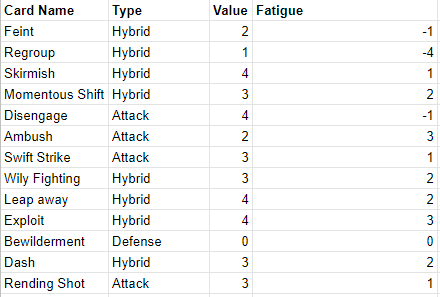
And changed the balance value calculation by substracting the fatigue value from it. I got this graph as a result:
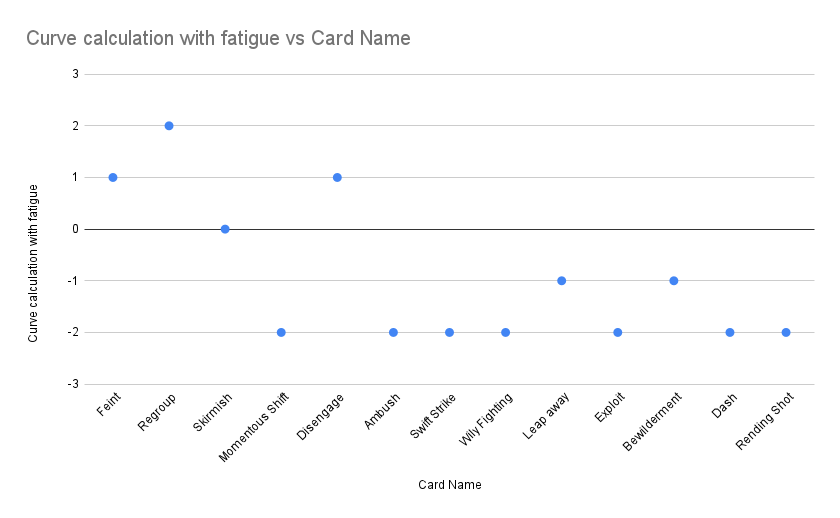
Fatigue values added
The graph shows an expansion of the range of card balance values. Previously it was +1 to -1 with the exception of Regroup whereas now the range extends from +2 to -2. This adds more possibilities to change how a card is perceived and how it affects combat. Regroup feels underwhelming in most of the cases due to almost never hitting the draw 2 cards instead condition. Now that Regroup also offers a flat -4 to fatigue, it turns out to be a great way to get back in the action and not getting that extra card doesn’t feel so bad. I hope to test this system out one day and reflect on whether that’s a valid way to approach adding layers to the combat of Unmatched.