Game Balance: Progression in PvE Games
PvE is an acronym for “player versus environment” meaning that a player or multiple players compete against the computer, not each other. The opposite of PvE is PvP - “player versus player”, but that will be discussed in another post.
Progression in PvE games typically means narrative or level progression, but can also refer to skill progression as is often the case with speed runners who optimize and perfect narrative progression through the game to be as fast as possible. This involves memorizing an incredible amount of information, good muscle memory, and impeccable timing on part of the player.
Friction
The game offers resistance which slows down the progression and is more commonly referred to as friction. Friction is what the player must overcome in order to achieve their goal or get a reward. This can come in the form of a puzzle, combat, collectible requirement, or something of the sort. Schreiber & Romero suggest friction to be visualized as a graph and divide it into four stages:
1. Discovery
2. Learning
3. Mastery
4. Fluency
I highly recommend going through their definitions for these stages. Visualizing friction of a given game component or challenge can be done like so:
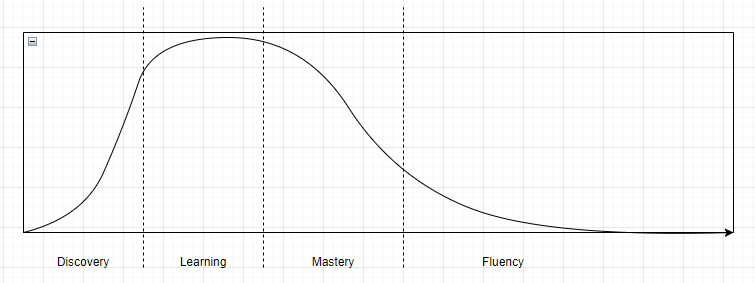
The X-axis showing the different stages of the challenge and the Y-axis representing the friction.
Perceived difficulty
As the friction graph above shows, the friction peaks at some point but quickly flattens out and the player internalizes the new skill or mechanic in the fluency phase. Although a game designer might try to create a perfect friction graph, the player might experience the difficulty completely differently. Players tend to see the progression as the first derivative of the curve and overestimate how much friction a particular challenge will offer. Below is an image showing how a player might perceive difficulty from where they are in the trajectory.
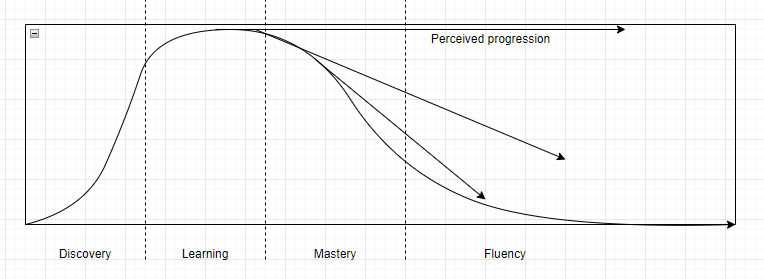
So as to not overburden the player to quit at the peak of the friction, game designers can design the challenge so that they place most of the challenge in the discovery and mastery phase while shortening the learning phase so that the player doesn’t spend too long thinking that they will never get over this challenge.
Gameplay arc vs. Gameplay loop
When discussing progression, it’s typical to discuss the “game loop” or the “game arc”. Commonly, a gameplay loop is a repeating cycle of progression whereas a gameplay arc is a one-time progression from one point of the game to another. In Enter the Gungeon, the game loop consists of choosing the character you want to play as and going through the dungeon -> dying or completing the dungeon -> do it again. With every passthrough of the gameplay loop, the player might unlock new characters, complete character backstories, or somehow bring about narrative progression. The gameplay arc in this game could be though of as, for example, starting the new game with no extra weapons or NPCs unlocked to having everything unlocked.
Extra friction - Diablo Hardcore
Players might sometimes add friction of their own volition, as is the case with playing Diablo games in the hardcore mode. This imposes permadeath and greatly affects how the players progress through the game. Especially on lower levels players might end up in situations way above the challenge they can actually face considering their gear and levels, but they might still give it a go rather than grinding away somewhere else. In hardcore mode, players don’t take on such huge risks but are very conscious of what level of risk they are comfortable with as loss aversion kicks in the more time they’ve invested in their character. Change any game to permadeath or take permadeath away from a game that already has it and you have a completely different experience.
Keeping the player challenged
As the player progresses through the game, they are assumed to get better at the game by either virtually increased character powers or increased player skill, or both! This means that game designers can’t just look at what gear the player has and increase the challenge by adding a bit more health to the enemy because the player deals a bit more damage. As stated, the players actual skill + any increased character powers, gear, or whatever is referred to as virtual player skill. Game designers must match and increase the virtual challenge of the game by either addressing the increase in the characters power or the players skill, or both (again)!
Looking at Super Mario Odyssey’s movement system, there’s a lot of variety and chances for players to hone their skills. You can progress through all of the levels and the game presents enemies that present slightly increased threat to Mario. Similarly, the puzzles become slightly more complex and might require you to perform a certain type of movement or chain multiple movements. Some players, though, are very experienced in platformers and neither the puzzles, platforming, nor enemies present much challenge to them but through level design there are optional goals and challenges that allow players to display mastery over the incredibly versatile movement. This allows players to also skip some parts of platforming by finding shortcuts, either intended or non-intended, by chaining multiple moves together. I found myself just experimenting of what can I actually skip and trying to find ways around the intended platforming experience which in itself present a new layer of play.
Elder game / End game
So what happens in a PvE game once the player reaches the end of the gameplay arc? Sometimes the player might just stop playing the game, reflecting on how nice or horrible it was, or even start a new game and try to go through it a bit differently. Some games on the other hand want the player to stay after reaching a certain end goal, like reaching the level cap in World of Warcraft. This state of play is typically referred to as “end game” or elder game in some literature. The goals might shift completely from leveling your character to gearing up, getting achievements, or gaining something other than levels or narrative progression. In WoW the end game offers players a load of raids requiring good reaction timing, planning, and coordination to complete. Even though players are not getting levels, they are receiving rare items that serve as rewards of recognition and prestige.
The core loop
Good game designers strive to create an enjoyable and engaging core loop for their games. A core loop the main activity that the player is engaged in and is the most activity that is continually repeated. For example, The Witcher 3’s core loop consists of dialogue and combat. If these weren’t enjoyable, the game would not be as revered as it is even if the story would be the best story known to mankind. The core loop of a game might be something that is used as friction for narrative progression through the game as is the case in The Witcher 3. Sometimes the core loop of a game might not be enjoyable but seen as a burden and menial task that leaves the player bitter and resentful. For me, such bad core loops exist in games that revolve around gathering and waiting, for example, FarmVille. Self-expression is something the game offers by allowing you to design how to place your crops and buy certain decorations, but the core loop consists of gathering, planting, and waiting. Thoroughly not enjoyable for me but might be for someone else.
Level caps
Lots of games have level caps either as hard limits (player literally can’t progress further in terms of level) or as soft limits (progression ramps exponentially making further progression virtually impossible). Imagining a game, let’s say World of Warcraft, without a level cap is an interesting way to look at how PvE progression works. In WoW, there’s a level cap that leads the players into the end game / elder game. What would happen if we remove that?
First, let’s think of why a level cap exists. First of all it allows designers to design the game keeping in mind the elder game. Knowing where the player will eventually end up helps in designing the pacing of the journey to that point. Secondly, it gives the player a goal or a milestone. Knowing there’s a level cap keeps the player focused on reaching the end and potentially pivoting their goal to now getting achievements, mastering PvP, getting prestige, or receiving rare in-game items. Without a level cap, the level progression starts to lose value. Getting a level from 2034 to 2035 doesn’t feel that exciting. So in WoW, a level cap let’s players have meaningful level progression and then introduce them to essentially a new game, where the goal is not to pursue quests and progress in levels, but to clear raids, gear up, and gain prestige. Removing the level cap and having infinite amounts of power with every ability unlocked and maxed out would make any choice of character build arbitrary - there’s no need to specialize since you can be everything all at once. Furthermore, designers would now have to find a way to create content that’s still engaging and challenging to demi-god player characters with infinite amounts of power.
Reward schedules
A typical characteristic of PvE games are rewards. These can be anything from achievements, collectibles, useful gear, or even narrative rewards, for example, getting a piece of information that reveals more about the game world’s lore. Let’s look at Vampire Survivors and the reward schedule in it. Vampire Survivors is a top-down rogue-like shoot ’em up bullet hell game (a mouthful but descriptive!). As a rogue-like, it has two progression systems: the overall arc and the core loop. The overall arc consists of unlocking all characters and finding all secrets, whereas the core loop consists of starting a level and surviving 30 minutes. You repeat the core loop and the core loop affects the overall arc, progressing it in some way.
As you start the game, you play through the first loop and most likely die without reaching minute 15. During your gameplay you receive coins that you use to upgrade your abilities and start anew. You might also unlock a new character after the first playthrough. How I experienced it, the game is designed to award you at the start after every single playthrough by unlocking a new character or map, letting you reach a further point in the game. After some time, the unlocks get a bit sparser but now you are able to consistently reach minute 30. Next you start to experiment with the weapons and items you unlock, finding cool combos and discovering what combos allow a weapon to “evolve”. These are hidden so you experiment more and more until all combos are known. But generally, you find one combo with every one or two playthroughs. I think the maximum core loops I played consecutively through without getting a reward was two. I’d argue that the reward schedule for Vampire Survivors is therefore designed to progress the overall arc every one to three core loops.
That’s the reward schedule for the overall arc, but what about the reward schedule within the core loop? There’s no level cap in Vampire Survivors but there are virtual power limits as you can only have a limited amount of weapons and items and they’re levels are capped. At the start, you level up quite fast, only having to kill a few enemies to level up and unlocking or upgrading a weapon or an item. This slows down because the experience needed feels feels like an exponential curve. It keeps the player invested for the start just through level-ups, but the game also introduces special enemies that drop chests on regular intervals. The intervals are static in so that the player can anticipate when the next reward is attainable by killing the special enemy.