Game Balance: Progression in PvP games
PvP is all about winning either by reaching a certain objective before your opponent or defeating your opponent. This is where overall power comes into play. Power in the sense of resources, gear, position, or whatever can be considered to affect the players standings is the key element in beating your opponent.
Before going deep into PvP progression, it’s important to go over a key concept. I’ve already touched on the topic of positive, negative, and zero sum games and economies but let’s reiterate. In the context of PvP a positive sum economy is an economy in which all players gain power over time - the total power in play increases over time. Here’s a simple graph showcasing how power develops over time.
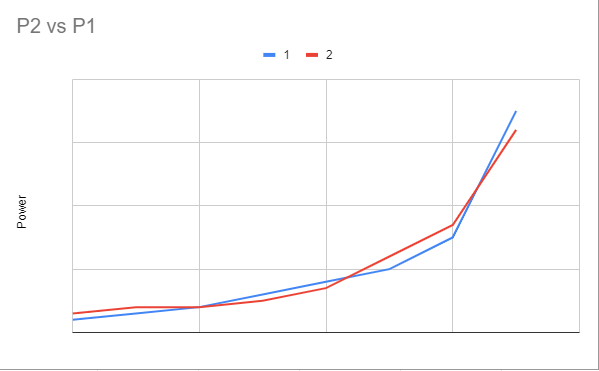
Positive sum economy
Power slowly develops and the one on top emerges victorious at some point, bringing the game to a conclusion. An example of a positive sum economy could be, for example, Terraforming Mars. All players gain power over time with a few exceptions that allow players to steal from one another or hinder them otherwise. Another example of a positive sum game would be Super Auto Pets. One person losing power doesn’t mean another one gains it or vice versa. In Super Auto Pets, everybody tries to ramp up their team to be the most powerful and defeat all other teams. The further you advance the stronger pets you’re able to purchase from the store, and the further the game goes on the higher stats or better abilities these pets will have.
A negative sum economy is one in which players gradually lose power - the total power in play decreases over time. Chess is an example of this with the exception that players can promote pawns. The amount of pieces at the start is the same for both but gradually both players start to take their opponents pieces off the board, reducing the amount of power in play. Here’s an example of a negative sum economy.
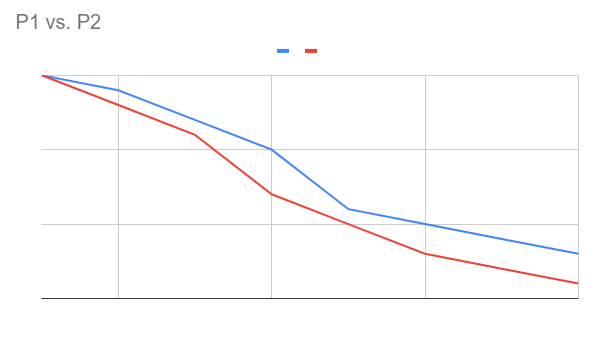
Negative sum economy
Lastly, a zero sum economy is an economy in which the total power in play stays the same but the relative power between players may fluctuate. This means that if one player loses power, the other gains it in equal terms and vice versa. Paying rent to another player in Monopoly is a zero sum mechanic in which the total amount of money in play doesn’t decrease but the relative distance in power between the players increases. Here’s an example graph of that.
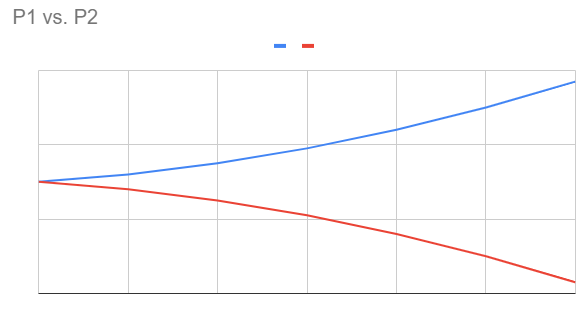
Zero sum economy
Changing Terraforming Mars from positive to negative sum
What if we would change Terraforming Mars from a positive sum economy into a negative sum economy? This would require sum fundamental changes and it definitely would change the nature of the game. Let’s call this version of the game Surviving Mars as it would include dwindling resources and players would need to survive as long as they can before resources run out.
First, every player would have a high starting production in some resources and some tiles owned. Every round a major natural disaster would happen, forcing players to choose which production to knock back by one from two options on top of losing a certain amount of resources. Every player could, for example, lose 10 gold worth of resources every round and every resource has a certain value, 1 gold equals 1 gold but 1 iron equals 2 gold and so on just like it’s currently implemented in game. The anti that every round forces the players to pay could go up exponentially, ensuring a swift death to those who don’t make it and allowing the game to finish without a boring on too long.
As Terraforming Mars is an engine-building game, it would still retain that characteristic. The difference is that the optimized engine is meant to sustain you so you outlive your opponents, not to grow you. Victory points could be given based still on similar bonuses that currently exist in the game, most energy production, most iron production, and e.g. last surviving player.
Bughouse chess
Bughouse Chess is a variant of chess that changes the nature of the game from a negative sum economy to zero sum economy. It is played in pairs and all captured pieces are transferred to your teammate to be deployed on their turn whether they so desire. This makes it so that no piece is every truly out of the game, just on being played on another board or waiting in the reserve of your teammate.
I highly recommend looking into it and testing it, the feeling is completely different from just playing regular chess. The victor is not clear from the get-go because there is always the possibility of a hail Mary checkmate when you receive that one crucial piece to complete it. Bughouse Chess is a great example of how you can change a negative sum game with one or two new mechanics into a zero sum or even a positive sum game.
Game length
In PvP, game length is crucial. To be more precise, the length of time each player gets to play is crucial. For example, imagine you have a free-for-all PvP game and rounds typically take 60 minutes. Say one player gets eliminated on minute 3 of the first round and there are 3 rounds to come. This isn’t very good design and most likely will result in a lot of churn as players will abandon games and queue up for another one rather than wait 57 minutes until they get to the second round. Equally important is the power distance of players over time. If one player is clearly ahead at minute 3 of a 60 minute round, the rest 57 minutes are just the leading player pounding the underdog to the ground - also not good. These issues can be dampened by adding some luck or rubber banding mechanics in the game but I won’t go over them now.
I’ve referenced Monopoly multiple times and I’ll do it again. Monopoly has the potential to be an unforgiving marathon lasting what seems to be forever due to it’s poor economy design. How would you go about shortening game length? You could remove money from the game after certain rounds, having to pay property tax to the bank. You could stop the influx of money after passing GO after the first three rounds. There’s multiple ways of shortening the game length here. But let’s take another game and think about how to lengthen it. Escape from the Aliens in Outerspace is a hidden-movement deduction game which pits humans against aliens. Aliens have to find humans on the map based on limited information and guess where to attack. I feel like the game has a good length with rounds taking around 30 minutes for bigger maps to 10 minutes with smaller maps with about 4-6 players who all know how to play the game.
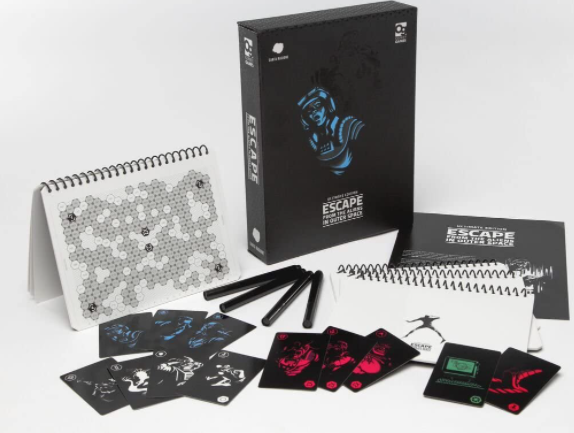
Escape from the Aliens in Outer Space
But let’s say I want to lengthen that time to a 60 minute round. First, I’d give all players a number of lives, so that if they get killed, they get to choose a respawn location. Instead of just reaching one escape hatch and escaping, humans would have to go around the map and activate at least 2 / 3 of all escape hatches to win. This would make getting the first escape hatch just as difficult as it was in the beginning, but now the humans will have to coordinate a bit to get the rest of the hatches activated as the aliens have less ground to cover. You could add more special cards, e.g. safety teleporter. Instead of dying when you get attacked, you get to move up to 3 hexagons from your current position. I’d argue that implementing these mechanics would already alter the game quite significantly and increase game time by a lot, as keeping track of all movement will also become convoluted. The more moves there have been made, the bigger the possibility space of potential routes is. Maybe I’ll try some custom rules next time I get the chance to play and report back!
Simplistic PvP: World War III
Schreiber & Romero give a design challenge: make as few rules modifications to the following game, and make it playable.
Players: any number
Setup: each player starts with 2 forces
Play: on each player’s turn, they can either gain 1 force or attack another player with any number of forces they wish. They lose all of those forces, and the opponent also loses an equal number of forces. If the player attacked with more forces than the opponent had, the opponent is also eliminated from the game.
End: when only one player is left in the game, they win.
The game is quite simple and reminiscent of Risk. Played optimally, there’s really no point in attacking especially in a game with more players. It’s best to just wait it out until your enemies have weakened themselves by attacking each other and then swooping in for the kill. But, of course, if everyone plays optimally the game stagnates. Now how could we fix this with the least amount of rules changes?
First, I’d make an attacking incentive. If one’s attack ends in the opponent being eliminated, the attacker gains forces equal to half of the forces of the opponent. Also, the force gain per round (1 force) is tied to attacking, force gain is incremental, and automatic at the end of a round. A player must have attacked during a round to gain forces, and the force gain is equal to the round number. After round 1, attackers gain 1 force; after round 2, attackers gain 2 force; etc.
For defense, everyone has a health pool of 20 (like MTG) and you can choose to defend or not. If you don’t defend, you don’t lose troops. This doesn’t apply to attackers, they will still lose their troops they attacked with but will deal damage to you.
So all changes:
- Health pools
- Defend or not
- Automatic, incremental force gain
- Force gain tied to attacking
Creating new content for Unmatched
Previously in my post about Game Balance: Combat I discussed a new mechanic designed for Unmatched, the board game. I created some supporting math for card costing and tested whether it works. I managed to get all cards within a range of power that extends from -2 to 2, so there are more powerful and less powerful cards. I designed a new character for Unmatched: Väinämöinen, and came up with some cards for it.
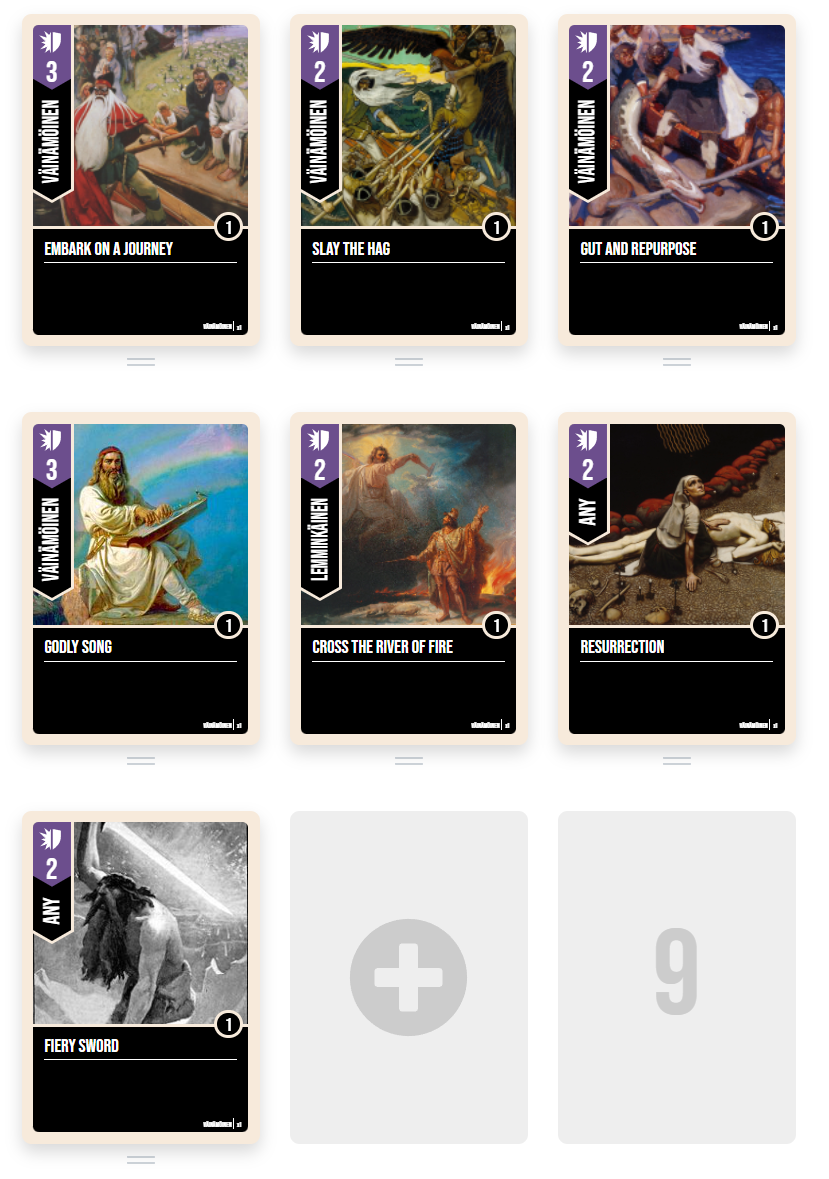
I didn’t completely design what unique stuff each card does and the numbers on the picture don’t represent what I plan to have as the final numbers. Anyways, I popped Embark, Slay the Hag, and Gut and Repurpose into my supporting math machine and got them to sit on the standard game curve pretty nicely:
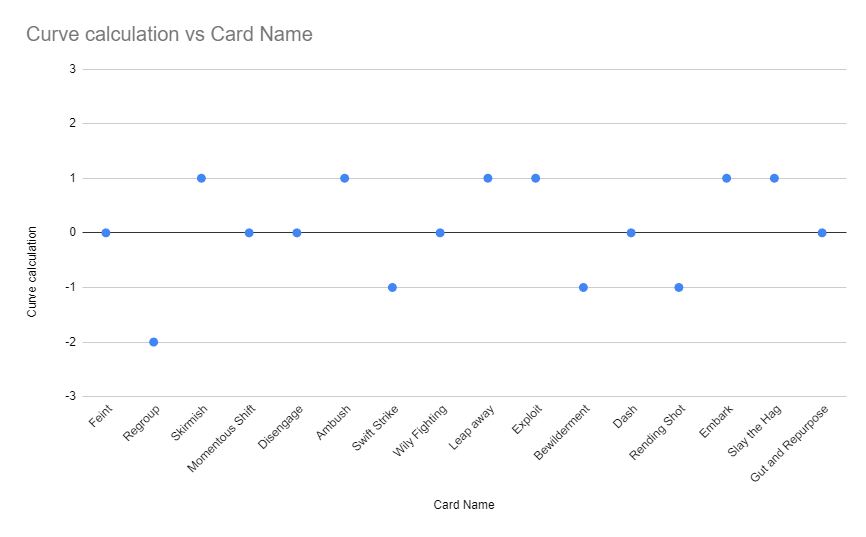
It’s nice to have supporting match and some sort of idea on balance, as I can use it as a basis for deciding the values and special effects of a card. I also popped the cards onto the fatigue adjusted curve:
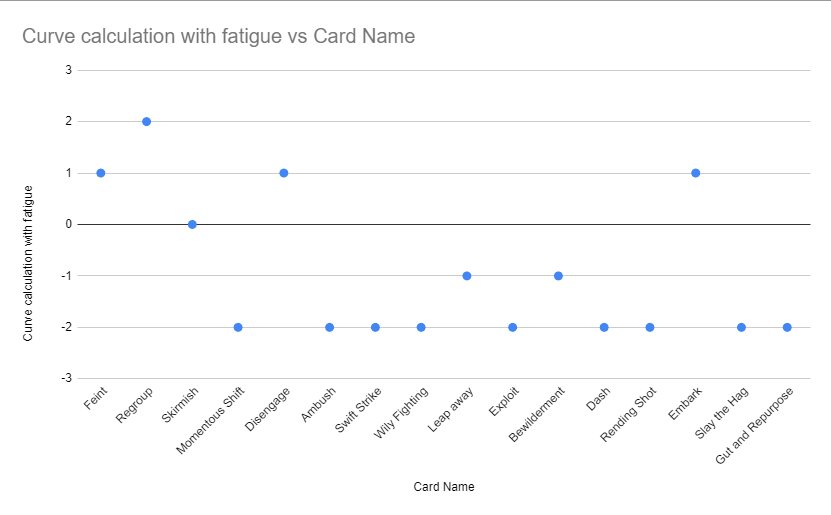
As you can see, Embark is a bit powerful but Slay the Hag and Gut and Repurpose are clearly underwhelming numbers-wise. I could then tune the special effect to be a bit more powerful to compensate for the low power of the card.
I’ll probably continue with the concept of Väinämöinen and try to come up with a completely unique deck for him that’s as balanced as I can make it!